Decimal vs Fractional vs American Odds — Complete Guide
Decimal vs Fractional vs American Odds — Complete Guide
You open a sports betting site for the first time, find a match you want to bet on, and immediately see numbers like 2.50, or 6/4, or +150. What do any of these mean? Which format is being used? And how do you know how much you will actually win?
Betting odds formats are one of the biggest stumbling blocks for beginners. This guide explains all three formats — decimal, fractional, and American — in plain language. By the end you will be able to read any odds on any sportsbook confidently, convert between formats, and calculate your potential winnings instantly.
Quick Answer: All three odds formats say the same thing — the probability of an outcome and how much you win — they just express it differently. Most beginners find decimal odds the easiest to understand.
Why Are There Different Odds Formats?
Odds formats developed in different regions of the world, each becoming the standard in its local betting market:
- Decimal odds — dominant in Europe, Australia, Canada and most online sportsbooks worldwide
- Fractional odds — traditional in the United Kingdom and Ireland, still widely used there
- American odds (Moneyline) — standard in the United States for all sports betting
Most modern online sportsbooks let you switch between formats in your account settings. Understanding all three means you can bet on any platform anywhere in the world without confusion.
Decimal Odds — The Easiest Format for Beginners
Decimal odds are expressed as a single number with a decimal point — for example 2.50, 1.80, or 4.00. They represent the total return you receive per unit staked, including your original stake.
How to Read Decimal Odds
The formula is simple: Winnings = Stake × Decimal Odds
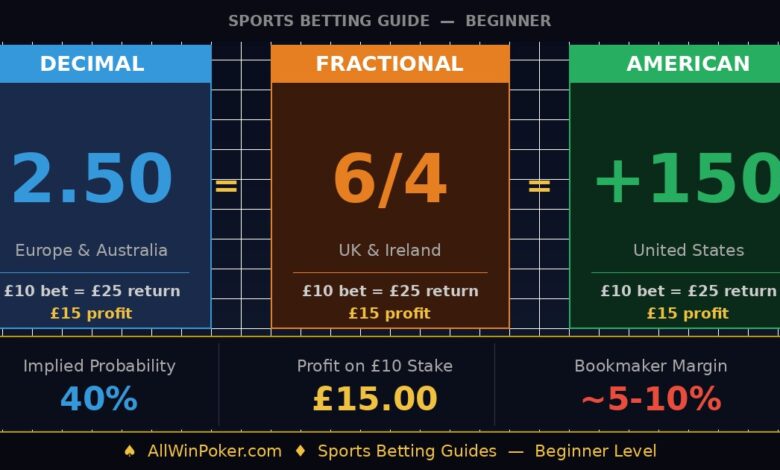
If the odds are 2.50 and you bet £10:
- Total return = £10 × 2.50 = £25
- Your profit = £25 — £10 stake = £15
What the Number Tells You
Any decimal odds above 2.00 means you win more than your stake. Below 2.00 means you win less than your stake (the outcome is considered likely by the bookmaker).
| Decimal Odds | Meaning | £10 Bet Returns | Profit |
| 1.10 | Very strong favourite | £11.00 | £1.00 |
| 1.50 | Strong favourite | £15.00 | £5.00 |
| 2.00 | Even money (50/50) | £20.00 | £10.00 |
| 3.00 | Moderate underdog | £30.00 | £20.00 |
| 5.00 | Underdog | £50.00 | £40.00 |
| 10.00 | Big underdog | £100.00 | £90.00 |
Why beginners love decimal odds: You always know your exact total return at a glance. Just multiply your stake by the number. There is no extra calculation needed.
Fractional Odds — The Traditional British Format
Fractional odds are written as two numbers separated by a slash or hyphen — for example 5/2, 6/4, or 1/3. They are also called traditional odds or UK odds.
The fraction tells you how much profit you make relative to your stake. The left number (numerator) is what you win; the right number (denominator) is what you must stake.
How to Read Fractional Odds
The formula: Profit = Stake × (Numerator ÷ Denominator)
If the odds are 5/2 and you bet £10:
- Profit = £10 × (5 ÷ 2) = £10 × 2.5 = £25
- Total return = £25 profit + £10 stake = £35
Common Fractional Odds Explained
| Fractional Odds | Also Called | £10 Bet Profit | Total Return |
| 1/10 | 1 to 10 on | £1.00 | £11.00 |
| 1/4 | 1 to 4 on | £2.50 | £12.50 |
| 1/2 | Evens on | £5.00 | £15.00 |
| EVS (1/1) | Evens | £10.00 | £20.00 |
| 6/4 | 6 to 4 | £15.00 | £25.00 |
| 5/2 | 5 to 2 | £25.00 | £35.00 |
| 10/1 | 10 to 1 | £100.00 | £110.00 |
Tip: When the left number is smaller than the right (e.g. 1/3), it means the bookmaker considers this outcome very likely. When the left number is bigger (e.g. 5/1), it is an underdog. EVS or 1/1 means even money — your profit equals your stake.
American Odds (Moneyline) — The US Format
American odds, also called moneyline odds, are expressed as a positive or negative number — for example +150, -200, or +350. They are standard on US sportsbooks and increasingly appear on international platforms for American sports like NFL and NBA.
The positive or negative sign tells you immediately whether you are looking at an underdog or a favourite.
Positive American Odds (+)
Positive odds show how much profit you make on a £100 stake.
If the odds are +150 and you bet £100:
- Profit = £150
- Total return = £250 (profit + stake)
You can scale this to any stake: bet £10 at +150, profit = £15, total return = £25.
Negative American Odds (-)
Negative odds show how much you must stake to win £100 profit.
If the odds are -200 and you want to win £100:
- You must bet £200
- Total return = £300 (£100 profit + £200 stake)
Scaled down: bet £10 at -200, profit = £5, total return = £15.
| American Odds | Type | £10 Bet Profit | Total Return |
| -500 | Strong favourite | £2.00 | £12.00 |
| -200 | Favourite | £5.00 | £15.00 |
| -110 | Slight favourite | £9.09 | £19.09 |
| +100 | Even money | £10.00 | £20.00 |
| +150 | Slight underdog | £15.00 | £25.00 |
| +300 | Underdog | £30.00 | £40.00 |
| +1000 | Big underdog | £100.00 | £110.00 |
Memory trick: Positive = profit on £100. Negative = cost to win £100. The bigger the negative number, the bigger the favourite. The bigger the positive number, the bigger the underdog.
All Three Formats Side by Side — The Same Bet
Here is the same set of outcomes shown in all three formats so you can see exactly how they relate to each other. Bet amount is £10 in each case.
| Decimal | Fractional | American | Implied Probability | £10 Profit |
| 1.25 | 1/4 | -400 | 80% | £2.50 |
| 1.50 | 1/2 | -200 | 66.7% | £5.00 |
| 2.00 | 1/1 (EVS) | +100 | 50% | £10.00 |
| 2.50 | 6/4 | +150 | 40% | £15.00 |
| 3.00 | 2/1 | +200 | 33.3% | £20.00 |
| 4.00 | 3/1 | +300 | 25% | £30.00 |
| 6.00 | 5/1 | +500 | 16.7% | £50.00 |
| 11.00 | 10/1 | +1000 | 9.1% | £100.00 |
Implied Probability — What the Odds Really Tell You
Every set of odds contains an implied probability — the bookmaker’s estimate of how likely an outcome is. Understanding this helps you judge whether a bet offers good value.
How to Calculate Implied Probability
| Odds Format | Formula | Example | Result |
| Decimal | 1 ÷ Decimal Odds × 100 | 1 ÷ 2.50 × 100 | 40% |
| Fractional | Denominator ÷ (Numerator + Denominator) × 100 | 2 ÷ (5+2) × 100 | 28.6% |
| American (+) | 100 ÷ (American Odds + 100) × 100 | 100 ÷ 250 × 100 | 40% |
| American (-) | Absolute value ÷ (Absolute value + 100) × 100 | 200 ÷ 300 × 100 | 66.7% |
The bookmaker’s overround: If you add up the implied probabilities of all outcomes in an event, they will always add up to more than 100%. That excess — typically 5% to 10% — is the bookmaker’s built-in margin. It is the sports betting equivalent of the casino house edge.
How to Convert Between Odds Formats
Most sportsbooks let you toggle the display format in settings. But if you need to convert manually, here are the formulas:
| Convert From | Convert To | Formula |
| Decimal | Fractional | (Decimal — 1) expressed as a fraction. e.g. 2.5 — 1 = 1.5 = 3/2 |
| Decimal | American (+) | (Decimal — 1) × 100. e.g. (2.50 — 1) × 100 = +150 |
| Decimal | American (-) | -100 ÷ (Decimal — 1). e.g. -100 ÷ (1.50 — 1) = -200 |
| Fractional | Decimal | (Numerator ÷ Denominator) + 1. e.g. 5/2 = 2.5 + 1 = 3.50 |
| American (+) | Decimal | (American ÷ 100) + 1. e.g. +150 ÷ 100 + 1 = 2.50 |
| American (-) | Decimal | (100 ÷ Absolute value) + 1. e.g. 100 ÷ 200 + 1 = 1.50 |
Which Odds Format Should You Use?
There is no universally superior format — it depends on what you find easiest to read and where you are betting. Here is a practical guide:
| Format | Best For | Advantage | Disadvantage |
| Decimal | Beginners and most online bettors | Easiest to calculate total return instantly | Less traditional feel for UK horse racing fans |
| Fractional | UK/Ireland horse racing fans | Traditional, widely understood in UK | Harder to compare odds at a glance |
| American | Betting on NFL, NBA, MLB, NHL | Shows favourite/underdog instantly via +/- | Confusing until you learn the two rules |
Our recommendation for beginners: Switch your sportsbook to decimal odds. They are the most transparent format — your total return is one simple multiplication. Once comfortable, learn the others so you can bet on any platform.
Real World Betting Examples Using All Three Formats
Example 1 — Premier League Football
Manchester City vs Arsenal. The odds for a City win are shown as:
- Decimal: 1.75
- Fractional: 3/4
- American: -133
You bet £20 on City to win. Your return: £20 × 1.75 = £35 total (£15 profit). All three formats say exactly the same thing.
Example 2 — Tennis Underdog
An underdog player is priced at:
- Decimal: 4.50
- Fractional: 7/2
- American: +350
You bet £10 on the underdog. Your return: £10 × 4.50 = £45 total (£35 profit).
Example 3 — Even Money Bet
A coin-flip style match where both teams are equally rated:
- Decimal: 1.91 (not 2.00 — the bookmaker takes a margin)
- Fractional: 10/11
- American: -110
You bet £11 on either team. Your return: £11 × 1.91 = £21.01 total (£10.01 profit). The slight difference from 2.00 is the bookmaker’s built-in margin.
Quick Reference — Odds Cheat Sheet
| If You See | Format | Quick Rule |
| 2.50 | Decimal | Multiply stake by this number to get total return |
| 5/2 or 5-2 | Fractional | Left number = profit per right-number staked |
| +150 | American | Profit on a £100 stake |
| -200 | American | Stake needed to win £100 profit |
| EVS | Fractional shorthand | Even money — profit equals stake (same as 2.00 decimal or +100) |
| 1/1 | Fractional | Even money — same as EVS |
| SP | Any | Starting Price — final odds at race start, not fixed in advance |
7 Tips for Beginners Reading Betting Odds
- Always set your sportsbook to decimal odds first — easiest to learn on
- Never bet without understanding what your potential return is — calculate it before placing
- Remember that odds below 2.00 (decimal) mean you win less than your stake
- Use implied probability to check if the bookmaker’s odds reflect your own view of likelihood
- Compare odds across multiple bookmakers — the same bet can have different prices
- The bookmaker always builds in a margin — you are not betting at true probability
- Bookmark an odds converter tool online for quick format switching until you are comfortable
Frequently Asked Questions
Which odds format is the most common worldwide?
Decimal odds are the most widely used format globally, especially on online betting platforms. Most international sportsbooks default to decimal and allow you to switch in settings.
Are American odds only used in America?
Not exclusively. While they are the standard in the US, many global sportsbooks show American odds for American sports like the NFL, NBA, and MLB even if the platform is based in Europe or Asia.
What does it mean when odds are described as short or long?
Short odds means the outcome is considered likely — the implied probability is high and the potential profit is small. Long odds means an underdog — low probability but a large potential payout if correct.
Can I change the odds format on my sportsbook?
Yes, almost all modern sportsbooks allow you to change the odds display format in your account settings or preferences. Look for a display options menu and choose your preferred format.
What is the difference between odds and probability?
Probability is the true likelihood of an outcome. Odds are the bookmaker’s interpretation of that probability, with a margin built in for profit. Implied probability is what you calculate from odds to reveal the bookmaker’s view — it always adds up to more than 100% across all outcomes.
Why are my odds showing as -110 for an even money bet?
Because -110 is not true even money — it is the bookmaker’s standard margin. To win £10 profit you must bet £11. The extra £1 represents the bookmaker’s cut. True even money would be +100 or 2.00 decimal, but bookmakers rarely offer this.
Conclusion — Read Any Odds in Seconds
Understanding odds formats is a fundamental skill for any sports bettor. Once you are comfortable with all three, you can:
- Bet on any sportsbook anywhere in the world without confusion
- Calculate your potential return instantly before placing a bet
- Understand the implied probability behind every price
- Compare odds across bookmakers to find the best value
- Spot when a bookmaker’s margin is unusually high
Start with decimal odds — get comfortable multiplying your stake by the number. Once that clicks, learn fractional for UK racing and American for US sports. All three become second nature with a little practice.
Responsible Gambling Notice
Sports betting should always be for entertainment. Understanding odds does not guarantee winning — the bookmaker always holds an edge. Set a budget before you bet and never chase losses. If gambling is affecting your life, visit BeGambleAware.org or contact the National Gambling Helpline.
This content is intended for adults aged 18 and over only.