Sports Betting for Beginners: How Odds Work

Sports Betting for Beginners — How Odds Work
| In this guide you will learn:
What sports betting odds actually mean, the three main formats used worldwide (decimal, fractional, and American), how to calculate your potential winnings, and what the bookmaker’s edge means for your bets. No prior knowledge required. |
1. What Are Sports Betting Odds?
Odds are numbers that tell you two things at once: how likely a bookmaker thinks a particular outcome is, and how much money you will win if your bet turns out to be correct.
Think of odds as a price tag on a prediction. When a bookmaker sets odds for a football match, they are essentially saying: based on our analysis, we believe Team A has roughly this much chance of winning — and we will pay you this much if you back them and they do win.
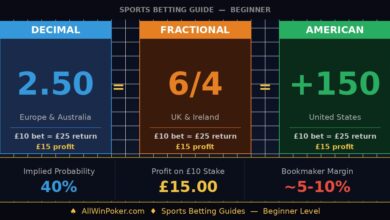
Odds are displayed in different formats depending on where you are in the world. In the UK, fractional odds are traditional. In Europe and Australia, decimal odds are standard. In the United States, moneyline (American) odds are used. Most reputable sportsbooks today let you switch between all three formats.
2. Decimal Odds Explained
Decimal odds are the simplest format for beginners because the maths is straightforward. The number shown represents your total return for every £1 staked — including your original stake.
How to Read Decimal Odds
| Odds | What It Means | £10 Stake Returns | Profit on £10 |
| 1.50 | Strong favourite | £15.00 | £5.00 |
| 2.00 | Even chance (50/50) | £20.00 | £10.00 |
| 3.00 | Moderate underdog | £30.00 | £20.00 |
| 6.00 | Unlikely outcome | £60.00 | £50.00 |
| 10.00 | Long shot | £100.00 | £90.00 |
The Formula
Total Return = Stake × Decimal Odds
Profit = (Stake × Decimal Odds) − Stake
Example: You bet £25 on a team at odds of 2.40. Total return = £25 × 2.40 = £60.00. Profit = £60.00 − £25.00 = £35.00
| 💡 Tip:
Decimal odds below 2.00 mean the bookmaker considers this outcome more likely than not. Odds of exactly 2.00 represent an implied 50% chance (before the bookmaker’s margin is applied). |
3. Fractional Odds Explained
Fractional odds are written as two numbers separated by a slash, such as 5/1 or 2/5. They represent profit only — your stake is not included in the calculation.
How to Read Fractional Odds
| Odds | Pronunciation | £10 Profit | £10 Total Return |
| 1/2 | One to two (odds-on) | £5.00 | £15.00 |
| 1/1 | Evens | £10.00 | £20.00 |
| 2/1 | Two to one | £20.00 | £30.00 |
| 5/1 | Five to one | £50.00 | £60.00 |
| 10/1 | Ten to one | £100.00 | £110.00 |
The Formula
Profit = Stake × (Numerator ÷ Denominator)
Total Return = Profit + Stake
Example: You bet £20 at odds of 7/2. Profit = £20 × (7 ÷ 2) = £70.00. Total return = £70.00 + £20.00 = £90.00
4. American (Moneyline) Odds Explained
American odds use a plus (+) or minus (−) sign in front of a number, always based on a $100 unit. They are standard on US sportsbooks and increasingly seen on international platforms.
Negative Odds (Favourite)
A negative number shows how much you must stake to win $100 profit. Example: −150 means you must bet $150 to win $100 profit (total return $250).
Positive Odds (Underdog)
A positive number shows how much profit you win from a $100 stake. Example: +200 means a $100 bet returns $200 profit (total return $300).
| Odds | Type | $100 Stake Profit | $100 Total Return |
| −200 | Strong favourite | $50.00 | $150.00 |
| −110 | Slight favourite | $90.91 | $190.91 |
| +100 | Even money | $100.00 | $200.00 |
| +150 | Underdog | $150.00 | $250.00 |
| +300 | Big underdog | $300.00 | $400.00 |
5. Comparing All Three Formats
| Decimal | Fractional | American | Implied Chance |
| 1.50 | 1/2 | −200 | 66.7% |
| 2.00 | 1/1 (Evens) | +100 | 50.0% |
| 3.00 | 2/1 | +200 | 33.3% |
| 4.00 | 3/1 | +300 | 25.0% |
| 6.00 | 5/1 | +500 | 16.7% |
| 11.00 | 10/1 | +1000 | 9.1% |
6. What Is Implied Probability?
Every set of odds carries an implied probability — the bookmaker’s estimate of how likely that outcome is to occur. Understanding implied probability helps you judge whether a bet represents good value.
How to Calculate Implied Probability
From decimal odds: Implied probability = 1 ÷ Decimal Odds × 100
Example: Odds of 4.00 → 1 ÷ 4.00 = 0.25 = 25% implied probability
From fractional odds: Denominator ÷ (Numerator + Denominator) × 100
Example: 3/1 → 1 ÷ (3+1) = 0.25 = 25% implied probability
From American odds (positive): 100 ÷ (Odds + 100) × 100
From American odds (negative): Odds ÷ (Odds + 100) × 100
| 💡 Value Betting:
If you believe the true probability of an outcome is higher than what the bookmaker’s odds imply, the bet is considered to offer positive value. If you think a team has a 40% chance of winning but the odds imply only 30%, that is a value bet. |
7. The Bookmaker’s Edge (Overround)
Bookmakers build a profit margin into every market they offer, known as the overround or vig. This is why, if you add up the implied probabilities for all outcomes in a market, the total always exceeds 100%.
A Simple Example
In a coin flip, the true probability of heads or tails is 50% each. A fair book would offer odds of 2.00 on both sides. But a bookmaker might offer 1.90 on each side instead.
Implied probability of heads at 1.90: 1 ÷ 1.90 = 52.6%. Implied probability of tails at 1.90: 52.6%. Total: 105.2% — that extra 5.2% is the bookmaker’s built-in edge.
In football markets, the overround typically ranges from 4% to 10%. In niche markets or live betting, it can be significantly higher.
8. Common Types of Bets for Beginners
Single Bet
One selection, one outcome. The simplest bet — you pick a result and if it happens you win. Best choice for beginners.
Accumulator (Parlay)
Multiple selections combined into one bet. All selections must win for the bet to pay out. Higher risk, higher reward. A £5 accumulator on five teams at 2.00 each would return £160 if all five win — but one loss wipes everything.
Each Way Bet
Common in horse racing. Your stake is split in two — half on the selection to win, half on the selection to finish in a placed position. You can profit even if your pick does not win outright.
Over/Under (Totals)
You bet on whether a stat — most commonly goals in football or points in basketball — will be over or under a set number.
Handicap Betting
The bookmaker gives one team a virtual advantage or disadvantage to level the playing field. Example: Chelsea −1.5 means Chelsea must win by two or more goals for your bet to win.
9. Beginner Tips Before You Place Your First Bet
- Start with single bets. Accumulators are tempting but accumulate risk just as fast as they accumulate potential returns.
- Only bet what you can afford to lose. Treat your betting budget as entertainment spend, not an investment.
- Understand the market before betting. Bet on sports you already follow and understand well.
- Compare odds across bookmakers. Getting even slightly better odds makes a real difference over time.
- Keep records of your bets. A simple spreadsheet tracking stakes, odds, and results will help you improve.
- Ignore guaranteed winning tips online. No one can reliably predict sporting outcomes.
- Set deposit and loss limits. Most licensed bookmakers allow you to set daily, weekly, or monthly limits.
⚠️ Remember: Sports betting should be enjoyable, not stressful. The bookmaker has a mathematical edge on every market. Most recreational bettors lose money over time. Never chase losses and never bet more than you planned.
10. Frequently Asked Questions
Q: Which odds format is easiest for beginners?
Decimal odds are widely considered the most beginner-friendly because calculating returns requires only one simple multiplication. Most online sportsbooks default to decimal odds and allow you to switch formats in your account settings.
Q: Can I convert between odds formats?
Yes. Every format expresses the same underlying probability and payout, just written differently. Most betting sites have a built-in odds converter tool.
Q: What does it mean when odds change before an event?
Odds move in response to betting activity, team news (injuries, suspensions), and the bookmaker’s risk management. A team’s odds shortening usually means a lot of money is being placed on them.
Q: Is sports betting legal?
Legality varies by country and region. In the UK, sports betting is fully legal and regulated by the UK Gambling Commission. Always check the rules in your specific jurisdiction and only use licensed, regulated bookmakers.
Q: What is the minimum age to bet on sports?
In most countries including the UK, the legal minimum age for sports betting is 18. In some US states it is 21. Reputable bookmakers verify age during registration.
🔞 Responsible Gambling Notice: This article is for informational and educational purposes only. Gambling involves risk and is not a reliable source of income. If you feel your gambling is becoming a problem, please seek help. Resources include BeGambleAware (begambleaware.org), GamCare (gamcare.org.uk), and the National Gambling Helpline: 0808 8020 133 (free, 24/7 in the UK). You must be 18 or over to gamble.