Texas Hold’em vs Omaha Poker — Which Should You Learn First? | AllWinPoker
Texas Hold’em vs Omaha — Which Poker Variant Should You Learn First?
If you are new to poker, you have almost certainly heard of Texas Hold’em. It is the most popular poker variant in the world and the one you see on television, in casinos, and in online lobbies everywhere. But spend any time in poker communities and you will quickly encounter its close rival: Omaha, also known as Pot-Limit Omaha or PLO.
Both games share the same community card structure. Both use the same hand rankings. Yet they play very differently — and choosing the wrong one to start with can make your learning journey much harder than it needs to be.
In this guide, we compare Texas Hold’em and Omaha side by side, explain the key rule differences, and help you decide which variant makes the most sense for your goals as a beginner.
Quick Comparison: Texas Hold’em vs Omaha
Here is a side-by-side overview of the two variants before we dive into the detail:
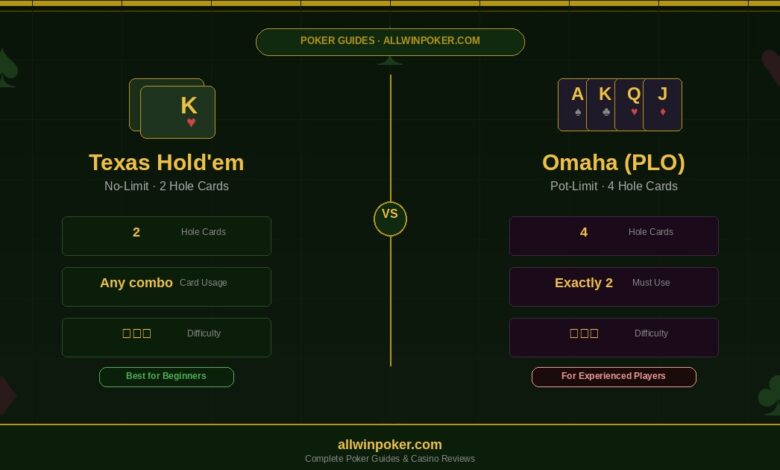
| Feature | Texas Hold’em | Omaha |
| Hole Cards Dealt | 2 | 4 |
| Must Use From Hand | Any combination | Exactly 2 (mandatory) |
| Community Cards | 5 (flop, turn, river) | 5 (flop, turn, river) |
| Best Hand Uses | Any 2 hole + any 3 board | Exactly 2 hole + exactly 3 board |
| Difficulty Level | Beginner-friendly | Intermediate |
| Pot Type (common) | No-Limit | Pot-Limit (PLO) |
| Average Hand Strength | Moderate | Very high (more draw potential) |
| Bluffing Frequency | Higher | Lower (more strong hands) |
| Popularity | #1 worldwide | #2 worldwide |
| Best For | New players | Players with Hold’em experience |
What is Texas Hold’em?
Texas Hold’em is the dominant form of poker played worldwide. In a standard hand, each player receives two private hole cards. Five community cards are then dealt face-up in three stages — the flop (three cards), the turn (one card), and the river (one card). Players must make the best five-card hand using any combination of their two hole cards and the five community cards.
Crucially, you are not required to use both of your hole cards. You can use both, one, or even none — relying entirely on the board if it produces a five-card hand by itself. This flexibility is one of the reasons Hold’em is considered beginner-friendly.
Why Beginners Tend to Start with Texas Hold’em
- Only two hole cards to manage, making decisions simpler
- Vast library of free learning resources, books, and training videos
- Available at every skill level online and in live casinos
- Standard no-limit format rewards both aggression and patience
- Easier to understand pot odds and position with fewer variables
What is Omaha Poker?
Omaha looks very similar to Texas Hold’em on the surface. Players receive four hole cards instead of two, and the same five community cards are dealt across the flop, turn, and river. The hand rankings are identical to Hold’em.
Here is where the critical difference lies: in Omaha, you must use exactly two of your four hole cards and exactly three of the five community cards to make your best five-card hand. This rule is non-negotiable, and it is what catches beginners off guard.
For example, if you hold four hearts in your hand and there are two hearts on the board, you do not have a flush. You must use exactly two of your hole cards — so you would only contribute two hearts from your hand and need three hearts on the board to complete the flush. Missing this rule is the most common and costly mistake made by players transitioning from Hold’em.
The Four-Card Rule in Practice
Having four hole cards might sound like a massive advantage, and in terms of hand combinations it is — you have six possible two-card combinations instead of one. However, this also means your opponents have the same advantage. This leads to much stronger hands being made more frequently, which changes the entire strategic landscape of the game.
The 5 Key Differences That Matter for Beginners
1. Number of Hole Cards
Hold’em gives you 2. Omaha gives you 4. More cards means more combinations — but also more complexity when evaluating your hand strength.
2. The Mandatory Two-Card Rule
In Hold’em, you can use any combination of hole and board cards. In Omaha, you must use exactly two hole cards. This single rule changes everything about how you calculate draws, made hands, and nut potential.
3. Average Hand Strength
Because Omaha players hold four cards, the average winning hand is significantly stronger than in Hold’em. In Hold’em, a two-pair or small flush can win comfortably. In Omaha, you often need a full house or the nut flush to feel safe. This means calling and folding decisions require recalibration.
4. Bluffing Frequency
Texas Hold’em allows for more frequent bluffing. Because hand ranges are wider and board textures vary, skilled players can represent many hands credibly. In Omaha, because made hands are stronger on average and draw combinations are more visible, pure bluffs are far less effective and less common.
5. Pot Size and Variance
Omaha is most commonly played as Pot-Limit Omaha, meaning raises are capped at the current pot size. Despite this structure, pots in PLO tend to grow very large very quickly because of the draw-heavy nature of the game. This results in higher variance — bigger wins and bigger losses — which can be challenging for players managing a limited bankroll.
Pros and Cons: Texas Hold’em
| Texas Hold’em — Pros | Texas Hold’em — Cons | |
| Simple 2-card hand to manage | Very competitive at all levels | |
| Widely available online and live | Aggressive players can dominate | |
| Huge learning resources available | Limited hand variety at low stakes | |
| Easier to bluff and fold correctly | Can feel repetitive over time |
Pros and Cons: Omaha
| Omaha — Pros | Omaha — Cons | |
| More action, bigger pots | Mandatory 2-hole-card rule trips beginners | |
| Better for strong hand builders | Higher variance, bigger swings | |
| Exciting draw-heavy gameplay | Fewer learning resources available | |
| Growing online community | Harder to bluff effectively |
Which Variant Should You Learn First?
The answer for the vast majority of new players is Texas Hold’em, and the reasons are practical rather than subjective.
Hold’em is the most well-documented form of poker in history. There are thousands of books, training courses, YouTube channels, and free tools built specifically to help beginners improve. The player pool at micro and low stakes is large, which means you will always find a game. And the two-card format keeps the decision tree manageable while you are still learning fundamentals like position, pot odds, and pre-flop ranges.
Omaha rewards players who already understand poker fundamentals. The mandatory two-card rule, the inflated hand strengths, and the pot-limit structure all assume a level of comfort with hand reading and odds calculation that takes time to develop. Starting in Omaha without that foundation is likely to result in expensive mistakes and confusion.
When to Consider Moving to Omaha
Once you have spent meaningful time at the Hold’em tables and feel confident with:
- Pre-flop hand selection and position awareness
- Post-flop hand reading and board texture analysis
- Pot odds and implied odds calculations
- Basic bankroll management across sessions
…Omaha becomes an exciting and natural next step. Many experienced Hold’em players find PLO refreshing because of its action-heavy nature and the additional strategic layers introduced by the four-card hand.
Tips for Beginners Starting with Texas Hold’em
- Start at the lowest stakes available — micro stakes online or free play to begin
- Learn the basic pre-flop starting hand charts and stick to them early on
- Focus on position: acting last gives you a significant information advantage
- Study one concept at a time — pot odds, c-betting, or 3-betting, not all at once
- Review your hands after sessions to identify recurring mistakes
- Do not move up in stakes until you are consistently profitable at your current level
Key Terms Explained
| Term | Definition |
| Hole Cards | The private cards dealt face-down to each player |
| Community Cards | The shared cards dealt face-up in the centre of the table |
| Flop | The first three community cards dealt simultaneously |
| Turn | The fourth community card dealt after the flop |
| River | The fifth and final community card |
| Pot-Limit (PLO) | A betting structure where the maximum raise equals the current pot size |
| No-Limit (NL) | A betting structure where players can bet all their chips at any time |
| Nut Hand | The best possible hand given the current board cards |
| Variance | The natural swings in results due to luck over a given sample of hands |
| Position | Where a player sits relative to the dealer button — acting later is advantageous |
Summary
Texas Hold’em and Omaha are both excellent poker variants, but they are not equally suited to beginners. Hold’em offers a simpler rule set, a larger learning community, and a more manageable decision tree for new players. Omaha rewards experience and is best approached once you have built a solid foundation in the fundamentals.
Start with Texas Hold’em, invest time in learning the core concepts, and enjoy the journey. When you are ready for a new challenge, Omaha will be waiting.
Related Guides on AllWinPoker.com
- How to Play Poker for Beginners — Rules, Hands & Basic Strategy
- What is a Welcome Bonus? How Casino Bonuses Actually Work
- Sports Betting for Beginners — How Odds Work and How to Place a Bet
Responsible Gambling Notice
This article is intended for informational and educational purposes only. Poker and gambling involve real financial risk. Never play with money you cannot afford to lose. If you feel you may have a problem with gambling, please visit BeGambleAware.org or GamCare.org.uk for free, confidential support. You must be 18 or over to gamble.